Resistor Heat Dissipation Formula
The increase in temperature is proportional to the increase in energy. So the relevant equation is the equation for power in a circuit.

16 4 Thermal Resistance Circuits

Heat Sink Thermal Resistance Of Heat Sink

Heat Sink Thermal Resistance Calculation Easy Explanation
This energy goes into heat much like the way a ball of putty that falls off a cliff converts its potential energy to heat when it hits the ground.
Resistor heat dissipation formula. The explanation of this formula is. Any resistor in a circuit that has a voltage drop across it dissipates electrical power. This is the maximum power that can be dissipated from the resistor without it burning out.
Since the power is converted to heat a resistor has a maximum dissipation rating set by the manufacturer above which the resistor will be damaged. The heat dissipation within a resistor is simply the power dissipated across that resistor since power represents energy per time put into a system. P i v i 2 r v 2 r p iv i2 r fracv2r p i v i 2 r r v 2.
To find out we need to be able to calculate the amount of power that the resistor will dissipate. Differentiate this formula wrt to time. This electrical power is converted into heat energy hence all resistors have a power rating.
P i v if a current i flows through through a given element in your circuit losing voltage v in the process. Energy dissipation in resistors. The rate of conversion is the power of dissipation.
As a charge q moves through a resistor it loses a potential energy qv where v is the potential drop across the resistor. When a current flows through a resistor electrical energy is converted into heat energy. The rate at which the heat is dissipated is called power given the letter p and measured in units of watts w.
Energy dissipated per unit time charge passing through resistor per unit time energy dissipated per charge passing through resistor assuming the element behaves as a perfect resistor and that the power is completely converted into heat the formula can be re written by substituting ohms law v i r displaystyle vir into the generalized power equation. Tex delta e m c delta t tex e is energy m is mass c is specific heat look it up for copper and t is temperature. In a resistor power dissipation is defined by ohms law p i2 r power dissipated equals current through the resistor squared times the resistance in ohms.
Heres the general rule for calculating power dissipation. The heat generated in the components of a circuit all of which possess at least some resistance is dissipated into the air around the components.

Heat Transfer In Power Resistors Use Of Heat Sinks Digikey

Smt Resistor Thermal Design And Layout Tempo Automation

Free Flat Plate Heat Sink Calculator

Heat Transfer In Power Resistors Use Of Heat Sinks Digikey

Thermal Calculation Example For A Simple Electronic

Composite Wall With Series Parallel Configuration

Heat Sink Thermal Resistance Calculator

Heat Dissipation Mechanism Renesas Electronics

How To Select A Suitable Heat Sink

Basics Power Dissipation And Electronic Components Evil

Understanding The Neher Mcgrath Calculation And The Ampacity
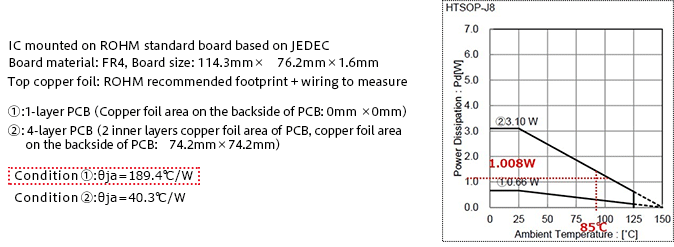
Heat Calculation For Package Selection Example 2 Basic


Comments
Post a Comment